
Care & services
Shockwave Therapy
Shockwave therapy is a device-based procedure that delivers acoustic pressure waves to a selected area. A condition-specific discussion can help you understand why it is being considered, what remains uncertain, and how your response would be reviewed.
The name covers more than one technology and protocol. Focused and radial devices, energy settings, labeling, intended uses, and operator requirements can differ. Those distinctions matter more than broad claims about “regeneration” or treating the root cause.
PurposeWhat the service is intended to address
FitHow candidacy and alternatives are discussed
ProcessWhat an appointment may involve
SafetyLimits, precautions, and questions
Why the specific device and diagnosis matter
“Shockwave therapy” can refer to different technologies, devices, settings, and intended uses. Before choosing treatment, ask which manufacturer, model, and technology will be used; why it is being considered for your diagnosed concern; what training and safeguards apply; and which contraindications or symptoms would rule it out.
Do not assume that registration, listing, or a general product description means a device is FDA approved or cleared for every condition. Shockwave therapy should not be presented as guaranteed to regenerate tissue, create blood vessels, repair nerves, remove calcium or scar tissue, require a set number of visits, provide minimal downtime, or produce a particular result.
Understanding the modality
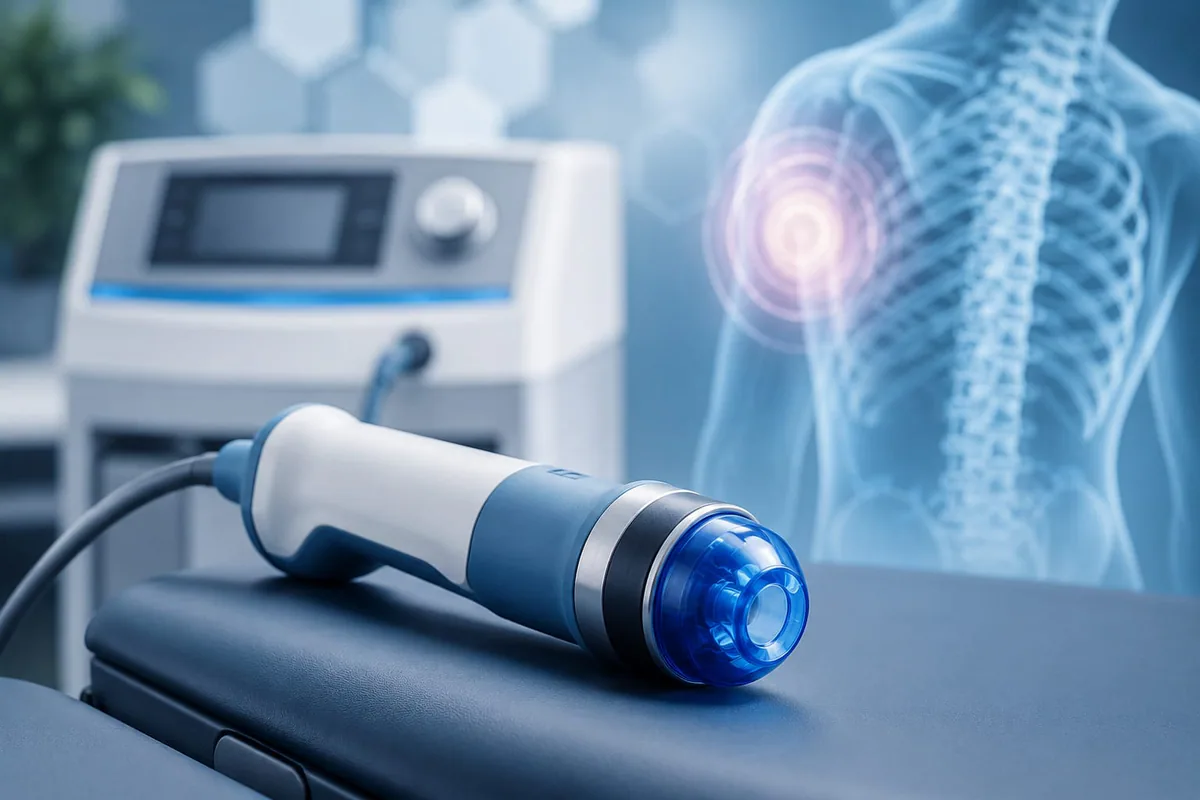
Depending on the technology, an applicator is positioned at a defined treatment area and a clinician selects device-specific parameters. A coupling medium such as gel may be used. You may feel repeated tapping or pressure, and comfort can vary by site and setting. The clinician should explain the expected sensations, duration, reasons to stop, and post-visit guidance for the proposed protocol.
Regulatory wording requires precision. FDA establishment registration or device listing does not establish that a product is approved, cleared, or authorized. Even when a particular device has a regulatory pathway for a particular use, that status cannot be generalized to every shockwave device, diagnosis, protocol, or clinic claim.
Research also varies by condition and protocol. For example, NICE has characterized efficacy evidence for extracorporeal shockwave therapy in Achilles tendinopathy as inconsistent and limited in quality and quantity, with special attention to consent and outcome audit. The point is not that all uses are equivalent; it is that the exact indication and evidence must be discussed honestly.
How candidacy should be evaluated
-
Establish a working diagnosis
The clinician should ask where symptoms occur, how they began, what loads or movements affect them, and what evaluation or treatment has already occurred. Pain alone does not identify the tissue involved.
-
Screen health history and the treatment area
Medications, bleeding risk, pregnancy, circulation or sensation changes, infection, malignancy, growth plates, implants, recent procedures, and other factors may affect the decision. This is not a complete contraindication list; the specific device instructions and your clinical assessment should guide the decision.
-
Match the device to the intended use
If shockwave is considered, the specific equipment and protocol should be appropriate for the diagnosed concern. A broad list of possible uses does not establish that the treatment fits your situation.
-
Agree on goals and review
The consent discussion should include evidence limits, reasonable alternatives, potential discomfort or harms, costs, expected monitoring, and stop criteria. A functional goal—such as tolerating a specific activity—is more useful than a promised pain score or timeline.
What to expect if care is appropriate
The clinician should identify the treatment area, explain positioning and equipment, and invite feedback throughout the session. You should know what sensations are expected, what should prompt an immediate stop, and what activity guidance applies afterward. The plan may also include education or progressive exercise when clinically appropriate; shockwave should not automatically replace active rehabilitation or other indicated care.
Session number, spacing, pricing, insurance handling, and activity restrictions can vary. Ask for those details before treatment and avoid assuming that another patient’s schedule or a general online description applies to you.
Common questions
Is shockwave the same as an electrical shock?
No. The modality uses acoustic pressure waves. The exact type and delivery depend on the specific equipment.
Is it painless or risk-free?
That cannot be promised. Discomfort and adverse effects can occur, and risks depend on the device, area, protocol, and individual health factors.
Will it replace injections, medication, or surgery?
This page does not advise replacing indicated care. Compare options with the relevant healthcare professional, especially when a diagnosis is uncertain or another clinician is already managing it.
When should I seek medical care first?
Major trauma, suspected fracture or dislocation, rapidly worsening weakness, a hot swollen joint with fever, chest pain, trouble breathing, or another emergency needs prompt assessment. Call 911 for an emergency.